Pendulum Review 2026: Strains, the Glucose Control Study and What GLP-1 Probiotic Really Is

A probiotic named “GLP-1” is bound to confuse people. Pendulum, a microbiome company, sells a capsule with that name alongside a diabetes-focused product called Glucose Control, and both lean heavily on the language of clinical science. Some of that science is real. Some of it is preclinical, and some is a customer survey. This review separates the three.
We read the labels, the refund policy, the one published human trial behind Glucose Control, and a 2021 advertising-watchdog decision on Pendulum’s claims. Here is what the evidence does and doesn’t show, and the fine print to know before you sign up.
What “GLP-1 Probiotic” means, and what it doesn’t
GLP-1 is a gut hormone involved in appetite and blood sugar. Prescription weight-loss drugs mimic it. Pendulum’s GLP-1 Probiotic is not one of those drugs and is no substitute for one. The company states plainly on its product page that the capsule “does not contain GLP-1 and is not a GLP-1 agonist drug,” and its benefit claims are footnoted “Based on preclinical studies. Not intended for weight loss.”
The idea is that certain bacteria produce compounds, such as butyrate and propionate, that may support the body’s own GLP-1 signaling. That mechanism comes from lab and animal work. The impressive-looking 91% and 88% craving figures on the page come from a six-week consumer survey of 274 people, with no placebo group. That is useful marketing feedback, not proof.
The strains, named
Unlike many probiotic brands, Pendulum prints strain identifiers on its labels, so you can see where products overlap.
| Product | Label type | Strains | Potency | Daily dose |
|---|---|---|---|---|
| GLP-1 Probiotic | Supplement Facts | Akkermansia muciniphila WB-STR-0001, Clostridium butyricum WB-STR-0006, Bifidobacterium infantis | 500 million AFU plus 211mg inulin | 1 capsule |
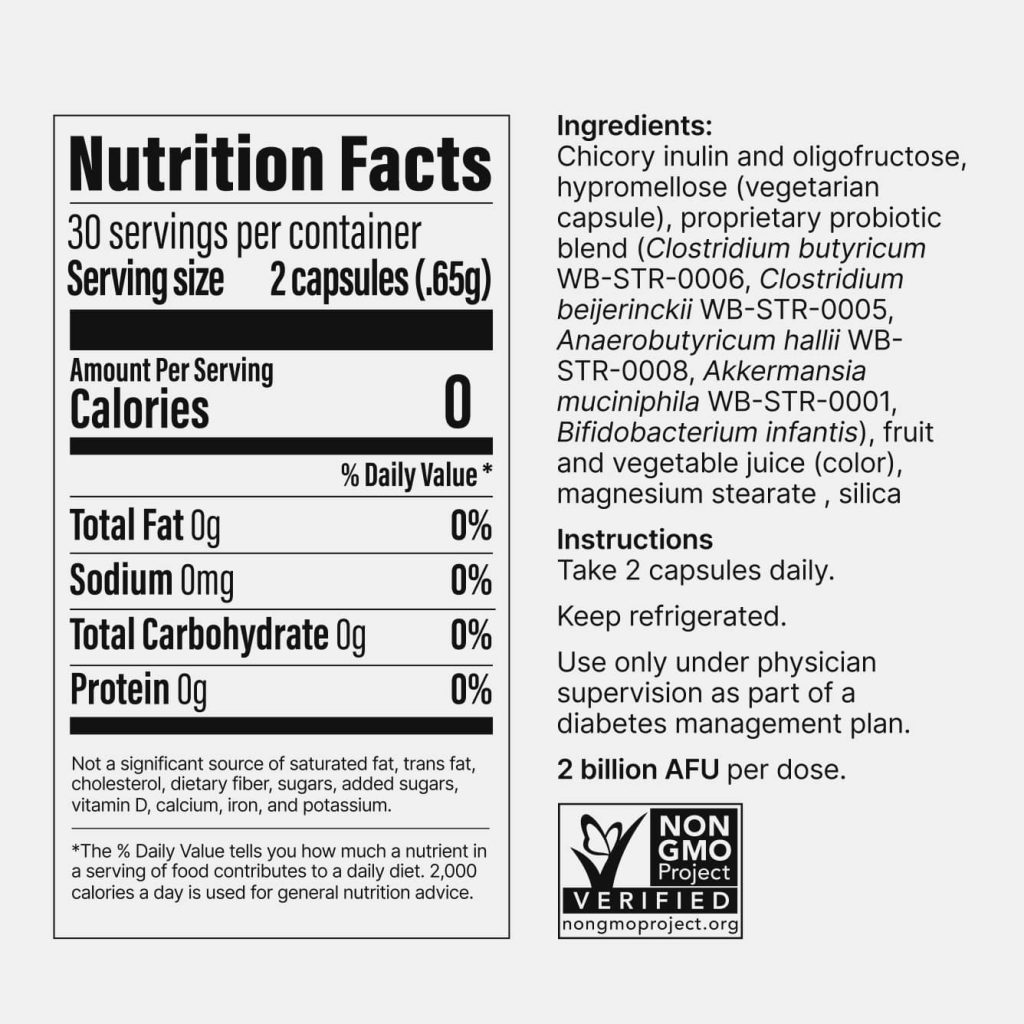
| Glucose Control | Nutrition Facts | The three above plus Clostridium beijerinckii WB-STR-0005 and Anaerobutyricum hallii WB-STR-0008 | 2 billion AFU per dose | 2 capsules |
| Metabolic Daily | Supplement Facts | Same five species as Glucose Control | 300 million AFU | 1 capsule |
| Akkermansia | Supplement Facts | Akkermansia muciniphila WB-STR-0001 | 100 million AFU | 1 capsule |
Akkermansia is the distinctive ingredient. Pendulum describes it as a strict anaerobe that can only survive without oxygen, which makes it tricky to manufacture, and the company says it grows it in its own oxygen-free U.S. facility. It also says its batches are third-party tested and made in an FDA-registered GMP facility, though it does not name the testing lab.
The Glucose Control study, read closely
Pendulum’s strongest claim rests on one trial: Perraudeau and colleagues, published in BMJ Open Diabetes Research & Care in 2020 (registered as NCT03893422). It was a 12-week, double-blind, placebo-controlled study at six U.S. centers. The details matter:
- Size: 76 adults with type 2 diabetes were randomized, and only 23 received the five-strain formula that became Glucose Control. The final analysis compared 21 people on that formula with 16 on placebo.
- Who paid: every author was a Pendulum employee and stockholder, and no outside grant was declared. That doesn’t make the results wrong, but it is industry research.
- Results: the primary outcome, total blood glucose after a test meal, improved versus placebo by 36.1 mg/dL/180 min, at p=0.0500, right at the usual cutoff. A1C fell 0.6 versus placebo, but with p=0.0540, so it narrowly missed conventional statistical significance. Within the treated group, A1C dropped by 0.2.
- The 32.5% figure: this is a median within-group drop in post-meal glucose rise, compared with a 26.4% median increase in the placebo group. It is not a straightforward 32.5% improvement over placebo.
- Context: most participants were already on metformin, and the authors themselves flag the small sample and the higher placebo dropout (10 people versus 2) as limitations.
Fair summary: a promising proof-of-concept result that needs a larger independent trial. Pendulum presents it more confidently than the paper does.
Supplement or medical food? The regulatory picture
GLP-1 Probiotic, Akkermansia and Metabolic Daily are sold as dietary supplements, which the FDA does not approve before sale. Glucose Control is positioned differently. When it launched in 2020, trade press reported it as classified as a medical food, available without a prescription. Its current label uses a Nutrition Facts panel and says “Use only under physician supervision as part of a diabetes management plan.” That positioning is not an FDA approval: under FDA guidance, medical foods do not have to undergo premarket review or approval.
In March 2021 the National Advertising Division reviewed Pendulum’s Glucose Control advertising. It found the core A1C and glucose-spike claims supported, but recommended limiting them to people taking metformin and removing percent-reduction figures for glucose spikes. As of our November 2026 check, the product page still cites the 32.5% number and the homepage does not mention metformin.
How ordering works, step by step
- Pick a product or take the site’s quiz. Each product page offers a membership, Pendulum’s word for a subscription, alongside a one-time purchase.
- Choose a plan: monthly, or prepaid three- or six-month supplies. Subscription orders ship free.
- Optional HSA/FSA: after checkout you can fill out a health questionnaire with Burst; licensed providers review it for a letter of medical necessity, and reimbursement depends on approval.
- Delivery: Pendulum says most U.S. orders arrive in 4–7 business days.
- Storage: the GLP-1 Probiotic label says to refrigerate for optimal quality, and the Glucose Control label says to keep it refrigerated, though that product page tells you to store it in a cool, dry place. Follow the label.
There is no clinician visit or prescription; support is by email and an online help center.
Fine print and red flags
- The guarantee is narrow. It covers only your first order of a product, and you must take it daily for 30 consecutive days, or twice daily for 90 days with three bottles for Glucose Control, and request the refund within 14 days after that trial window. For Glucose Control, the refund applies only if your A1C didn’t drop.
- No returns at all outside the guarantee, and shipping is never refunded.
- Cancellation deadline: memberships must be canceled by the Sunday before the next charge; a shipped order is not refunded.
- Testimonials: Pendulum discloses that people in promotional testimonials may have received compensation or free product.
- Packaging is mid-change: you may get an amber or a white bottle.
Who Pendulum suits, and who should skip it
It suits adults with type 2 diabetes who want to add Glucose Control to an existing plan with their doctor’s agreement, and people curious about Akkermansia who accept that most claims rest on preclinical data. Skip it if you want a substitute for a prescribed GLP-1 drug or diabetes medication, if you expect weight loss, or if strict membership cancel timing would be a hassle.
Frequently asked questions about Pendulum
Does Pendulum GLP-1 Probiotic work like Ozempic?
No. It contains no GLP-1 and no drug. It is a three-strain probiotic whose GLP-1 claims are based on preclinical research, and Pendulum says it is not intended for weight loss.
Is Glucose Control FDA approved?
No. It is labeled for use under physician supervision for the nutritional management of type 2 diabetes. Neither medical foods nor supplements go through FDA approval.
How strong is the evidence for Glucose Control?
One company-run trial with 23 people randomized to the formula. The meal-glucose result reached borderline significance; the A1C change of 0.6 versus placebo narrowly did not.
Can I take Pendulum with metformin?
Most study participants were on metformin, but any combination with diabetes medication should be cleared with your prescriber first.
Verdict: transparent labels, overconfident marketing
Pendulum earns credit for naming its strains, publishing a peer-reviewed trial and making genuinely unusual anaerobic probiotics. It loses points for a product name that invites confusion with GLP-1 drugs, survey-based craving numbers, and Glucose Control claims that read stronger than the small, company-funded study behind them. We rate it 3.6 out of 5: worth a careful look for the right person, with your doctor in the loop.
Pendulum Glucose Control is labeled for use only under physician supervision as part of a diabetes management plan and is not a replacement for medication your clinician has prescribed.
These statements have not been evaluated by the Food and Drug Administration. This product is not intended to diagnose, treat, cure or prevent any disease. Talk to a healthcare professional before use, especially if you take medication, are pregnant or nursing, or have a medical condition. This article is general information, not medical advice.
Related reading
Affiliate & medical disclosure: This review is independent and for information only, not medical advice. Some links may be affiliate links; we may earn a commission at no cost to you, which never affects our score. Consult a licensed provider before starting any product.