Live Vital Peptide Programs Guide 2026: What Each Protocol Costs and Does
Open the Live Vital menu and the first thing you notice is that it isn’t a weight-loss shop wearing a lab coat. There’s a skin peptide, a recovery stack literally named Wolverine, a mitochondrial compound most people have never heard of, and a metabolic track that skips GLP-1s entirely. That breadth is the appeal and the confusion, so this Live Vital peptide programs guide walks through what each protocol actually is, what it costs per month, and the kind of person it fits.
One thing up front, because it changes how you should read the rest. Every protocol here is prescription-only. You fill out a roughly ten-minute intake, Dr. Patrick Taylor reviews it, and if approved, a licensed US compounding pharmacy fills and ships the vial. So the real question isn’t “can I buy this,” it’s “which one is worth asking a physician about.”
The Live Vital peptide protocols, grouped by goal
Live Vital sorts its catalog into three buckets: skin, recovery and longevity, and weight and metabolism. The pricing runs on 10-week cycles billed monthly, and the per-month numbers below are what I confirmed on the individual treatment pages.
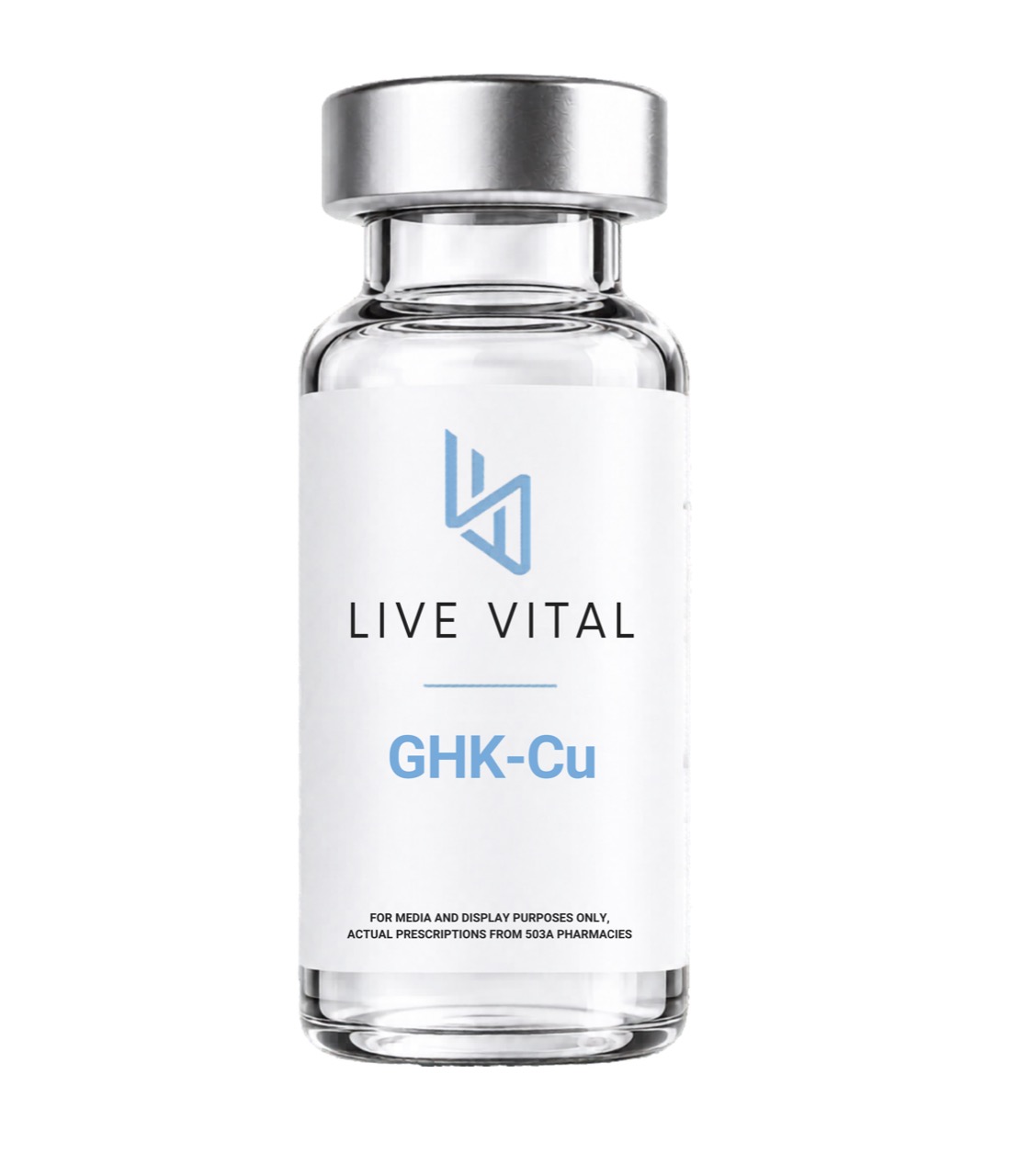
Skin. GHK-Cu is the entry point at $99 a month — a copper peptide with more published skin-repair research behind it than almost anything else on the menu, though most of that work is topical rather than injected. Step up to the Glow or Klow stacks at $149 a month if you want GHK-Cu bundled with complementary compounds. If skin is your one goal, start with plain GHK-Cu before paying for a stack.
Recovery and longevity. This is the deepest section. BPC-157 and TB-500, the two peptides most associated with tissue and injury recovery, each run $99 a month. The Wolverine recovery blend and CJC-1295/Ipamorelin — the growth-hormone-axis pairing — both sit at $116. Glutathione, the antioxidant workhorse, is $119, and NAD+ rounds out the cellular-energy side of the shelf. This bucket is where the health-optimizer crowd tends to live.
Weight and metabolism. No semaglutide here. MOTS-c, a mitochondrial-derived peptide, is $149 a month, and Tesamorelin tops the priced menu at $166. Tesamorelin is worth a note: it’s the one compound on the list that’s actually FDA-approved, though only for HIV-associated lipodystrophy, so its metabolic use here is off-label and physician-directed. If you came looking for a straightforward GLP-1 program to drop 20 pounds, this track will feel oblique — it’s aimed at body recomposition and metabolic signaling, not appetite suppression, and that distinction trips up a lot of first-time buyers.
NAD+ sits a little outside the three neat buckets, marketed on the cellular-energy and longevity side. The science that NAD+ levels fall with age is solid; the open question, honestly, is how much a supplemental protocol restores function in an otherwise healthy adult. It’s a fine example of the pattern across this whole catalog — a real mechanism, an incomplete answer on outcomes.
Cost and fit at a glance
| Protocol | Goal | Price/month | Best fit |
|---|---|---|---|
| GHK-Cu | Skin repair | $99 | Skin-first beginner |
| BPC-157 | Recovery | $99 | Nagging injuries, gut |
| TB-500 | Recovery | $99 | Soft-tissue recovery |
| CJC-1295/Ipamorelin | GH axis, sleep | $116 | Recovery + sleep quality |
| Wolverine (blend) | Recovery stack | $116 | Hard trainers |
| Glutathione | Antioxidant | $119 | Longevity dabblers |
| Glow / Klow | Skin stack | $149 | Skin, past the basics |
| MOTS-c | Metabolism | $149 | Non-GLP-1 metabolic |
| Tesamorelin | Weight/metabolism | $166 | Physician-directed metabolic |
The brand advertises a range up to about $299 a month once you get into its higher-tier stacks, so treat the numbers above as the single-peptide and common-stack floor, not the ceiling.
The honest catch
Here’s what the tidy per-month pricing hides: these are 10-week protocols, not one-off bottles. A “$99 a month” peptide is really a two-to-three-month commitment before you can honestly judge whether it did anything, so the true cost of trying GHK-Cu is closer to $250-300, not $99. Budget for the cycle, not the first charge.
The second catch is evidence. These are compounded peptides, and outside of Tesamorelin’s narrow approval, none are FDA-approved for the uses Live Vital targets. Some compounds have real mechanistic research; others are genuinely early-stage with mostly preclinical data. That’s not a knock on Live Vital specifically — it’s the state of peptide science in 2026 — but it’s exactly why the prescriber-review step matters and why “researched” shouldn’t be read as “proven.”
How to pick one without overspending
Match a protocol to a single, measurable goal, then commit to one cycle before adding anything. Chasing better skin? GHK-Cu at $99. Coming back from a stubborn tendon issue? BPC-157 or TB-500, same price. Training hard and sleeping badly? CJC-1295/Ipamorelin at $116 is the classic recovery-and-sleep pick. Curious about a non-GLP-1 metabolic angle? MOTS-c or Tesamorelin, with your physician’s input carrying real weight given the off-label use.
Baseline yourself first with photos, sleep notes, or training numbers, use the direct messaging with the care team for dosing and side-effect questions, and loop in your own doctor if you take other medications. That last step isn’t a formality here — it’s the whole point of a supervised platform.
Frequently asked questions
Do I need a prescription to use Live Vital peptides?
Yes. Every protocol requires a medical intake reviewed by Dr. Patrick Taylor, and approved prescriptions are filled by a licensed US compounding (503A) pharmacy. There’s no over-the-counter option.
Which protocol should a beginner start with?
Pick the single peptide tied to your top goal rather than a stack — GHK-Cu ($99) for skin, BPC-157 ($99) for recovery. Run one 10-week cycle, judge the result honestly, and only then consider adding a second compound.
How are the peptides shipped and taken?
They arrive as compounded vials from the pharmacy and are typically self-administered by subcutaneous injection per your clinician’s dosing instructions. Your care team walks you through it through the secure portal.
Is the pricing really $99 to $166 a month?
Those are the per-month figures for the single peptides and common stacks I priced. Higher-tier stacks push the brand’s advertised range up toward $299, and because protocols run 10 weeks, plan on multiple months of billing before evaluating results.
Related reading
Affiliate & medical disclosure: This review is independent and for information only, not medical advice. Some links may be affiliate links; we may earn a commission at no cost to you, which never affects our score. Consult a licensed provider before starting any product.