Musely Hair Solution Review: Hair Pill, Classic & Modern Topicals vs Hers and Nutrafol
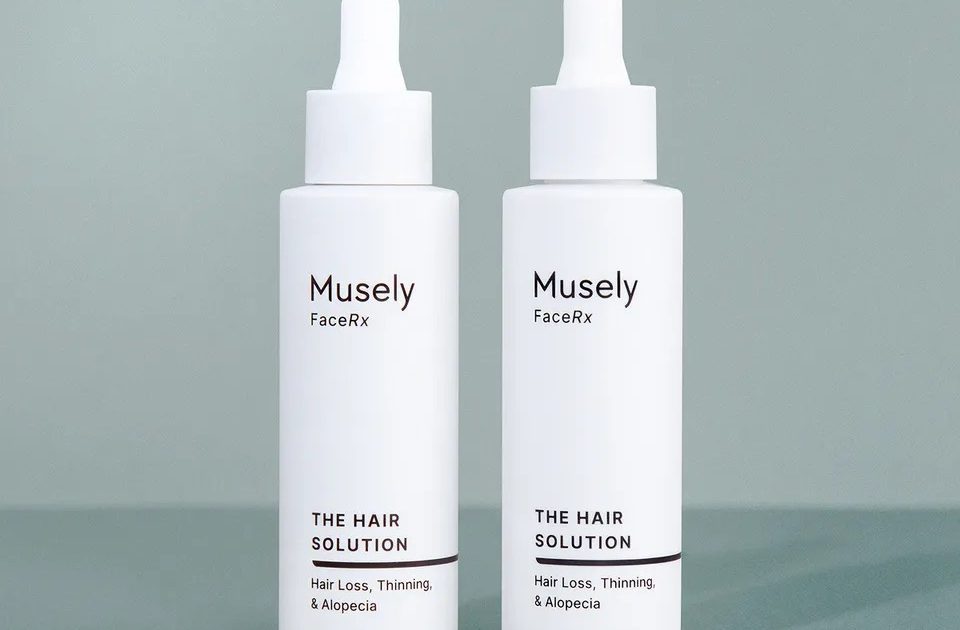
Hair loss treatment has quietly changed in the last few years. Low-dose oral minoxidil went from an off-label curiosity to something dermatologists prescribe routinely. Compounded topicals now mix several drugs into one bottle. And newer ingredients like exosomes and latanoprost have entered the conversation. Musely, best known for dark-spot creams, now sells a full hair lineup built around those trends, plus a lash serum and a facial-hair cream. Here’s what each product contains, how long it realistically takes to work, and how it compares with Hers, Nutrafol and plain drugstore Rogaine.
For the basics of how Musely’s doctor review and pharmacy work, see our Musely FaceRx review. For the skin side of the brand, read our breakdown of Musely’s anti-aging line.
The hair lineup at a glance
| Treatment | Key actives | Auto-refill | One-time |
|---|---|---|---|
| Hair Pill | Oral minoxidil + dutasteride (men); minoxidil + dutasteride or spironolactone (women) | $32/mo (3-month supply) | $136 |
| Topical Solution – Classic | 8% minoxidil + dutasteride (and spironolactone for women), with tretinoin, ketoconazole, hydrocortisone | $33/mo (3-month supply) | $141 |
| Topical Solution – Modern | 250 million exosomes + latanoprost, with melatonin, caffeine, cetirizine, biotin | $36/mo (3-month supply) | $154 |
| Topical Solution – Bundle | Modern + Classic, used together daily | $69/mo (3-month supply) | Subscription only |
| Lash Serum | 0.005% latanoprost | $33/mo (3-month supply) | $141 |
| Facial Hair Cream | 6% eflornithine | $41/mo (2-month supply) | $117 |
Prices from musely.com at the time of writing. New prescription orders carry a one-time online doctor-visit fee of about $20 at checkout.
The Hair Pill: oral minoxidil with a DHT blocker
Minoxidil keeps hair follicles in their growth phase longer. As a pill at low doses, it’s become a mainstream dermatology tool because it’s easier to stick with than a twice-daily scalp liquid. A 2025 American Family Physician summary of a randomized trial reported that low-dose oral minoxidil performed about as well as topical minoxidil. The deciding factor is often simply which one you’ll actually use every day.
Musely pairs it with a DHT blocker, because in pattern hair loss DHT is what shrinks follicles over time. Men get dutasteride, a stronger relative of finasteride. Women get dutasteride or spironolactone, depending on their history and plans. Both uses are off-label, and both carry important cautions. Neither drug is compatible with pregnancy, so women who could become pregnant need reliable contraception and a frank talk with the prescriber. Men should know that sexual side effects are possible with DHT blockers, though uncommon. Oral minoxidil can cause unwanted facial or body hair, ankle swelling or a faster heartbeat in some people. Tell your doctor about any heart conditions or blood pressure medication.
Musely reports that 84% of 5,505 patients saw improvement by day 60 and 97% after day 90. Those numbers are self-reported, and “improvement” often means less shedding before it means more hair.
Topical Classic and Topical Modern: two different philosophies
Classic is the “more of what works” approach: 8% minoxidil (store-bought Rogaine tops out at 5%) plus a DHT blocker, all in one solution. It also contains tretinoin to help the minoxidil absorb, ketoconazole (an antifungal shampoo ingredient with modest hair benefits), and a little hydrocortisone to calm the scalp irritation that high-strength minoxidil can cause. For people who don’t want a pill, it’s a smart, well-reasoned formula.
Modern takes the newer-science route: 250 million exosomes plus latanoprost, a glaucoma eye drop that’s known to grow eyelashes and has shown early promise on the scalp in small studies. Melatonin and caffeine have some lab and small-trial support for hair growth; cetirizine and biotin are minor supporting players. It doesn’t contain minoxidil. That makes it an option for people who don’t tolerate minoxidil, but it also makes it less proven.
The Bundle ($69 a month) combines both. Musely’s instructions are to apply Modern first, then Classic five minutes later. That’s a reasonable approach if one product alone hasn’t been enough, but it isn’t where we’d start.
Self-reported results: Classic, 74% by day 45 and 96% after day 90 (3,333 patients). Modern, 75% by day 45 and 95% after day 90 (4,222 patients).
The realistic timeline (and the shed nobody warns you about)
- Weeks 2–8: many people notice more shedding when they start minoxidil. It’s usually a sign that old hairs are being pushed out by new growth. It’s alarming, and it’s the number-one reason people quit too early.
- Months 3–4: shedding settles. Most people notice their part or hairline looks less sparse before they see real new hair.
- Month 6: this is the first fair point to judge visible density. Take photos in the same light every month from day one.
- Month 12: full assessment. If you stop, gains usually fade over the following months. These are maintenance treatments, not cures.
The Lash Serum and Facial Hair Cream
The Lash Serum uses 0.005% latanoprost, a close cousin of bimatoprost, the active ingredient in Latisse, the FDA-approved brand-name lash product. Expect fuller lashes over two to four months. Known side effects include eyelid darkening, and rarely permanent darkening of a light-colored iris, which is why this one belongs with a doctor rather than a beauty counter.
The Facial Hair Cream works the opposite way. Eflornithine slows the enzyme hair follicles need to grow, so upper-lip and chin hair grows back slower and finer between removals. It doesn’t remove hair, so you keep shaving, threading or waxing, just less often. Musely’s version is 6%; the branded prescription cream is 13.9%. Musely reports 86% improvement by day 30 and 93% after day 90 (6,056 patients, self-reported). One practical note: sudden coarse facial hair in women can be a sign of a hormonal condition such as PCOS, which is worth checking with a doctor rather than just treating.
Musely vs Hers vs Nutrafol vs Rogaine
| Musely | Hers | Nutrafol | Rogaine (OTC) | |
|---|---|---|---|---|
| What it is | Compounded prescriptions, oral and topical | Prescription and OTC minoxidil options | Non-prescription supplement | 2% or 5% minoxidil |
| Typical cost | $32–$36/mo; $69 bundle | Oral minoxidil reported from about $29/mo | About $79/mo on subscription, $88 one-time | Roughly $30–$45 per pack |
| DHT blocker included | Yes (dutasteride or spironolactone) | Depends on treatment chosen | No (botanical ingredients) | No |
| Doctor involved | Yes | Yes, for prescriptions | No | No |
The clearest difference is the DHT blocker. Most of the mild-to-moderate pattern hair loss we see comes down to two mechanisms, growth signaling (minoxidil) and follicle shrinkage (DHT). Musely’s pill and Classic topical address both in one product at around $32–$33 a month. That’s strong value next to Nutrafol, which costs more than twice as much and is a supplement rather than a medicine. Nutrafol can make sense for people who want a non-drug route or who have shedding tied to stress or diet, but it’s not a substitute for minoxidil in pattern loss. Hers is the closest like-for-like competitor and is priced similarly. Rogaine is the cheapest place to start, but it’s capped at 5% minoxidil and has no DHT blocker.
Before any of these, check the basics. Sudden or patchy hair loss, scalp pain or scaling, or hair loss after illness, childbirth or rapid weight loss can have other causes, including thyroid problems, iron deficiency or crash dieting. If you’ve lost weight quickly on a GLP-1 medication and noticed shedding, that’s usually temporary telogen effluvium, and protein intake matters more than a prescription.
Our verdict
For pattern hair loss, Musely’s Hair Pill and Topical Classic are well-designed, fairly priced prescriptions that combine the two treatments with the best evidence: minoxidil and a DHT blocker. Choose the pill if you know you won’t keep up with a twice-daily liquid, and choose Classic if you’d rather avoid a systemic drug. The exosome-based Modern topical is the experimental option, useful for people who can’t use minoxidil, but less proven. Whatever you choose, commit to six months, expect a temporary shed, take monthly photos, and keep your doctor in the loop about pregnancy plans and side effects. That’s what separates results from wasted subscriptions.
Related reading
Affiliate & medical disclosure: This review is independent and for information only, not medical advice. Some links may be affiliate links; we may earn a commission at no cost to you, which never affects our score. Consult a licensed provider before starting any product.