Oak Sermorelin Review 2026: Sign-Up, Safety and an Honest Look at the Fine Print

Sermorelin has become one of the most heavily advertised “longevity” peptides in telehealth, and Oak Longevity now offers it through a short online quiz with no video call required. The pitch is deeper sleep, faster recovery and leaner muscle from a nightly injection that prompts your body to make more of its own growth hormone.
This honest review walks through what happens when you sign up, who reviews your request, how the injections work day to day, what the safety screening looks like, and the fine print worth reading before you enter a card.
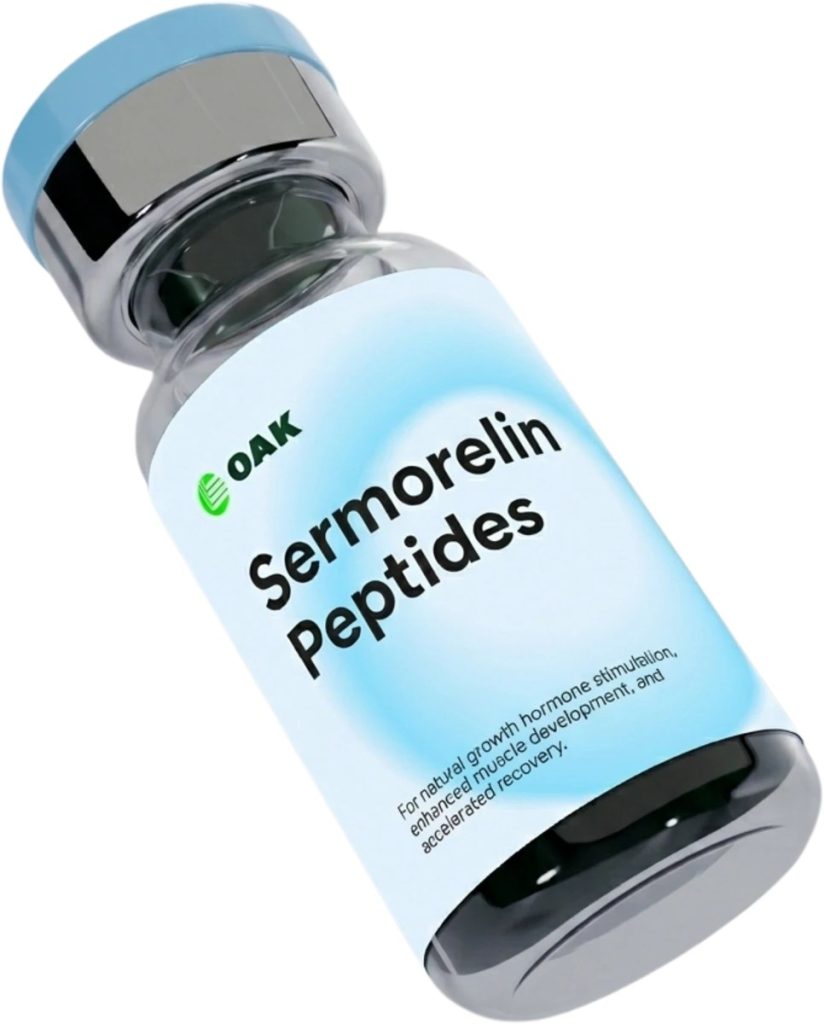
Oak Sermorelin at a glance
| Medication | Compounded sermorelin, made by a licensed US pharmacy (listed as 3 mg/mL) |
| Form and schedule | Subcutaneous injection, usually at bedtime; dose set by your provider |
| Clinician model | Independent physicians and nurse practitioners; online questionnaire where state law allows |
| Labs | Optional upload of results from the last 12 months |
| Eligibility | Adults 18 or older; checkout blocks Louisiana, New Mexico and Mississippi |
| Price range | $199 month to month; $147 a month on a prepaid year |
| Delivery | Ships 1-2 days after approval, tracked, in plain packaging |
How signing up works, step by step
1. Goals and a short explainer
The quiz opens by asking what you want most: deeper sleep, faster recovery, more energy or leaner body composition. A screen then explains that sermorelin “signals your pituitary gland” and that you are only charged if prescribed.
2. Health screening
You enter your date of birth and sex, then an email address so Oak can save your plan. Women are asked whether they are pregnant, could be, or are breastfeeding; a yes ends the quiz. Next comes a checklist of conditions, a heart history question, and follow-ups on autoimmune disease and blood clots.
3. Plan choice and card hold
If nothing disqualifies you, the app says you are “a great candidate” and moves to checkout before your medical details are complete. Your card is authorized, not charged. Oak’s terms say the hold is released if a provider declines you.
4. The rest of the intake
After checkout you add a phone number, height and weight, current medications, allergies, optional bloodwork and proof of identity (a photo ID or the last four digits of your Social Security number). You then sign informed-consent and truthfulness statements.
5. Review and shipping
Oak’s FAQ says most reviews finish the same day, and approved orders leave a US pharmacy within one to two days.
What the care model really is
Oak’s telehealth consent states that evaluations are done by “independent licensed physicians and nurse practitioners” contracted through its medical group partners, and that the evaluation can be based on an online questionnaire where state law permits. In practice that means asynchronous care, with no scheduled video visit and no required blood test. Follow-up happens by messaging your care team, who can ask the provider to adjust your dose. The consent form does say you agree to attend follow-ups or lab work if your provider asks.
Oak’s terms also describe the company as a platform connecting patients with providers and pharmacies, and state that Oak itself is not a HIPAA covered entity.
Using it: the nightly injection
This is a needle product, not a pill. Oak calls it “a short, fine needle under the skin before bed,” and its plans include the medication, injection supplies and shipping. Bedtime timing tracks the research: in a small study of older men, the growth hormone boost was concentrated in roughly the two hours after each dose. Oak does not publish dose ranges or how long a vial lasts; those details come with your prescription.
Safety, side effects and who gets screened out
Oak’s consent page lists common side effects as redness, swelling or pain at the injection site, flushing, headache, dizziness, nausea and trouble sleeping, and tells patients to seek care right away for signs of an allergic reaction. A 2020 research review in Translational Andrology and Urology likewise describes nausea, facial flushing and injection-site redness as the main reported problems, calling them rare.
The screening questions are fairly strict. The quiz disqualifies anyone reporting:
- Any cancer now or in the past (except non-melanoma skin cancer)
- A pituitary or hypothalamic tumor or lesion
- Pregnancy, possible pregnancy or breastfeeding
- Severe liver or kidney disease, or uncontrolled thyroid disease, blood pressure or diabetes
- A bleeding disorder or blood thinners such as warfarin or Eliquis
- An organ transplant, active seizures, or uncontrolled severe anxiety, panic disorder or migraines
- A heart attack, stroke, heart failure or similar event in the last 6 months
The screen relies entirely on your own answers, so leaving out a cancer history or a blood thinner defeats the only safety check in the process.
FDA status and how strong the evidence is
Sermorelin was once an approved drug. Geref injection was approved in 1997 to treat children with growth hormone deficiency, and an ampule form approved in 1990 was used to test pituitary function. EMD Serono discontinued both in 2008, and in 2013 the FDA formally determined they were not withdrawn for safety or effectiveness reasons. What Oak ships is different: a compounded version. The FDA states plainly that compounded drugs are not FDA-approved, and Oak’s own consent form calls use for wellness, sleep, recovery or body composition off-label.
The adult research is small. The 2020 review describes trials of 11 men over 6 weeks and 19 adults over 16 weeks; growth hormone and IGF-1 rose, and the longer trial found more lean mass but no change in body weight or body fat. The authors say larger long-term studies are still needed. Oak’s longevity page cites a 2006 article by Walker, which is an editorial rather than a clinical trial.
Fine print and red flags
- Mixed patient numbers. The quiz says “Join 150,000+ patients,” while Oak’s homepage claims 10,000+ satisfied patients. The 4.8 rating shown at checkout has no named source.
- Approval makes it final. Once a provider approves an order, it cannot be cancelled or refunded, even before it ships.
- Long plans carry exit costs. Leaving a multi-month plan early means repaying part of the discount, so start monthly if unsure.
- “Price forever” has limits. Checkout copy promises no changes, but the terms let the fee change with your dose or prescription.
- The guarantee is a coupon. If sermorelin does not work, Oak offers a discount on your next order, not your money back.
For how Oak handles its weight-loss programs and overall customer service, read our full Oak review.
Who it suits, and who should skip it
Oak Sermorelin fits a healthy adult who is comfortable with nightly self-injection, understands the evidence is limited, and wants a low-friction, no-video online process with supplies included. It suits people less well if they want a clinician to order baseline labs and track IGF-1, or if they expect visible fat loss.
Skip it, or talk to your own doctor first, if you have any cancer history, a pituitary problem, are pregnant or breastfeeding, take blood thinners, or have uncontrolled chronic disease. Competitive athletes should also check anti-doping rules before using any growth-hormone-releasing peptide.
FAQ
Do I need a video call or blood test to get Oak Sermorelin?
Usually not. Oak uses an online questionnaire where state law permits, and bloodwork is an optional upload, though your provider can request labs.
Is Oak’s sermorelin FDA-approved?
No. It is compounded by a licensed pharmacy. The only approved brand, Geref, has been off the market since its maker discontinued it in 2008.
Can women use it?
The quiz accepts women but disqualifies anyone pregnant, possibly pregnant or breastfeeding, and one landing page markets it to men.
Our verdict
Oak runs a fast sign-up with a thorough list of disqualifying conditions, clear consent language about compounding and off-label use, and supplies included in the price. Its weak points are the ones common to online peptide programs: asynchronous review without required labs, modest evidence for the benefits it advertises, and fine print that makes approved orders final. Keep expectations realistic, answer every health question fully, and start month to month.
Compounded medications are prepared by licensed pharmacies but are not FDA-approved, and the FDA has not evaluated them for safety, effectiveness or quality. A licensed clinician decides whether any prescription is appropriate. This article is general information, not medical advice.
Related reading
Affiliate & medical disclosure: This review is independent and for information only, not medical advice. Some links may be affiliate links; we may earn a commission at no cost to you, which never affects our score. Consult a licensed provider before starting any product.