Oricle Hearing Aid Review 2026: Honest Look at Fitting, Support, FDA Status & Fine Print
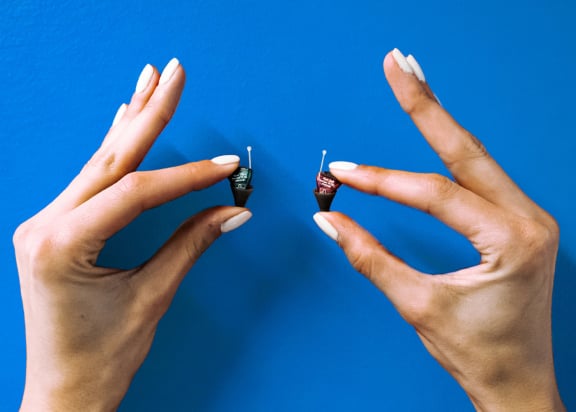
If you keep asking people to repeat themselves, a low-priced, no-appointment hearing aid sounds very appealing. Oricle Hearing, a San Diego company, sells exactly that: a tiny rechargeable in-ear device, shipped to your door with no exam or prescription. This review sets the price aside and looks at fitting, support, the fine print, and who should see an audiologist instead.
In short, Oricle is a legitimately registered over-the-counter (OTC) hearing aid seller with a basic product. Its marketing claims more than its paperwork backs up, and its return policy costs money to use. Both are worth knowing before you order.
OTC vs prescription hearing aids
Under the FDA’s OTC hearing aid rule, in effect since October 17, 2022, OTC devices are for adults 18 and older with perceived mild to moderate hearing loss, sold without an exam, prescription or audiologist fitting. Their maximum output is limited, so the FDA says they are not for severe or profound loss. Prescription aids work differently. You get an in-person hearing test, a fitting programmed from your audiogram, usually 1-3 follow-up adjustment visits and ongoing care. HearingTracker notes they are the only option for severe or profound loss.
Who should see an audiologist instead
The FDA’s required OTC label lists warning signs that call for a doctor before any hearing aid:
- Your hearing changed suddenly in the past 6 months
- Ear pain, or fluid, blood or pus coming from the ear
- Strong dizziness or a spinning feeling
- Ringing, or worse hearing, in only one ear
An audiologist is also the better route if your loss feels more than moderate or uneven, or if you want precise tuning. If none of this applies and your main trouble is following speech in groups, on the phone or in noise, an OTC trial is reasonable.
Ordering and fitting, step by step
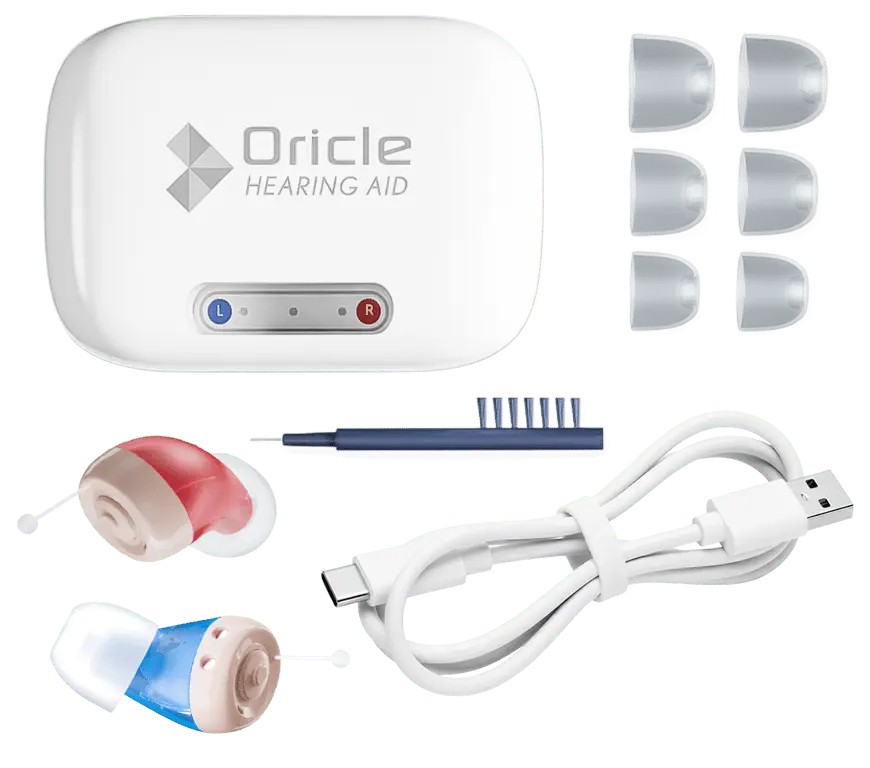
- Choose a color. The checkout offers Original (beige) and Onyx (matte black). Oricle’s images show a left (blue, “L”) and right (red, “R”) unit in one charging case.
- Watch the pre-checkout boxes. A Pro upgrade, a warranty and expedited processing are offered as checkboxes. A pop-up may also appear if you try to leave the page. Leave unticked anything you don’t want.
- Wait for delivery. Oricle’s policies say orders are processed within 1 business day and arrive in 3–6 business days. Other pages on the same site say 5-7 days or 3-10 days after shipment. Once an order is processed, it can’t be changed or canceled.
- Book the setup call. After you buy, Oricle emails you to schedule a free 30-minute video call with what it calls a hearing specialist. The call covers fit, settings and questions.
- Fit and adjust. Oricle’s own 3-step guide is: power on, adjust the volume with the included tool, then insert. You choose from silicone tips in 3 sizes.
Many OTC brands are self-programmed through a smartphone app; Oricle doesn’t advertise one. It is a preset device you adjust by volume, not one tuned to a hearing test, so expect trial and error. The FDA suggests testing a new aid in different settings, which matters because the refund window is 30 days from delivery.
What the device is, and what the FDA record shows
Oricle markets the aid as “FDA-registered.” The FDA’s own consumer page warns that wording like “FDA Registered” on OTC hearing aid labeling may be misleading. Registration means a company has told the FDA it makes or imports devices. It does not mean the FDA has reviewed how well a particular product works.
The public openFDA database does list Oricle Hearing LLC as an active registrant. It is listed as a manufacturer and initial importer, and its device is filed as a Class 2 “Self-Fitting Air-Conduction Hearing Aid, Over The Counter.” That listing points to 510(k) clearance K221052, which the FDA granted in 2023 to Huizhou Jinghao Medical Technology Co., Ltd. in China. That suggests a cleared design from an overseas maker sold under Oricle’s name, a common budget-OTC setup; the clearance doesn’t test Oricle’s marketing claims.
The descriptions conflict, too. The homepage describes “advanced analog chip technology,” while the box section calls the units “Advanced digital hearing aids.” Battery life is given as both 20 hours and 24 hours. Wareable tested the Pro model and recorded about 16 hours of continuous use per charge, well short of the brand’s up-to-48-hour claim.
App and support
There’s no companion app to fall back on, so support means people: phone and email, seven days a week from 5AM to 10:40PM Pacific time. Beyond the setup call there’s no ongoing professional care. Oricle also highlights an Au.D. clinician quote and says 909 clinicians recommend it on FrontrowMD without compensation. Those endorsements are presented by the brand. Neither one is a clinical evaluation of the device.
Fine print and red flags
| What the marketing says | What the policy or record says |
|---|---|
| “30 Day Satisfaction Guarantee”; an Oricle advertorial calls it a “full money-back guarantee” | A $4.95 fee and all shipping costs are deducted; you pay return postage; returns need approval and must ship within 7 days (one FAQ says 14) |
| “FDA-registered” | The FDA says this phrase may be misleading; the clearance on file belongs to a Chinese manufacturer |
| Extended warranty | Lost, stolen or water-damaged units are replaced at 75% off, not free, and may be refurbished |
| “Rated 4.7 by 500,000+ Happy Customers” | The same site also says 100,000+ customers and 200,000 orders; Trustpilot shows 4.0 from 1,822 reviews |
| News-style “7 reasons” page | Labeled at the bottom as an advertisement, with a disclosure that the site owner is paid |
The terms also require individual arbitration with a class-action waiver. You can opt out within 30 days by certified mail. Liability is capped at $500.00, and the terms include automatic-renewal clauses for any subscription you might accept later. That’s common for direct-to-consumer brands, but it narrows your options in a dispute.
What customers report
On Trustpilot, the company has claimed its profile, and opinion is split: 64% of reviews are five stars, but 21% are one star. Positive reviews mention helpful staff and fast delivery. Negative ones describe shipping delays, hard-to-reach support, difficult returns, buzzing, and devices that stopped working. One reviewer said a left unit failed after about 45 days, outside the return window.
Oricle experience FAQ
Do I need a hearing test before buying?
No. The FDA allows OTC purchases without an exam. A test is still the only reliable way to know whether your loss falls in the mild-to-moderate range these devices are designed for.
Is there an Oricle app for adjusting sound?
Oricle doesn’t advertise one. You change the volume with a tool and choose a tip size; the Pro adds preset programs rather than custom, audiogram-based fitting.
What happens if one unit stops working after 30 days?
Without the optional warranty, Oricle doesn’t publish any standard warranty coverage. With it, defects are covered for 1 year, and other problems get a discounted replacement.
Is Oricle a scam?
No. It is a real, FDA-registered company that ships an actual product. Its claims and policies are more favorable to the company than its headlines suggest, though, so read them before ordering.
Verdict: fine for a low-stakes trial, not a substitute for care
Oricle can be a sensible, cheap experiment for an adult with mild, even hearing loss who wants a discreet in-ear device and is comfortable with simple volume controls. The checkout pressure, the inconsistent specs, the “FDA-registered” framing and a return policy that charges fees all count against it on trust. Skip it if you have any of the FDA’s warning signs, uneven or more serious loss, or you want professional fitting and long-term support. If you do order, start the trial as soon as the aids arrive and keep the original packaging.
This article is general information, not medical advice. OTC hearing aids are intended only for adults 18 and older with perceived mild to moderate hearing loss. Talk to a doctor or licensed hearing professional about sudden hearing changes, ear pain or drainage, dizziness, or hearing loss in one ear.
Related reading
Affiliate & medical disclosure: This review is independent and for information only, not medical advice. Some links may be affiliate links; we may earn a commission at no cost to you, which never affects our score. Consult a licensed provider before starting any product.